Cross Border Parcel Shipping is... Dead: RIP
The exemptions that built direct-to-consumer e-commerce are being switched off everywhere. What replaces them, and the customs-duty lever many brands miss.
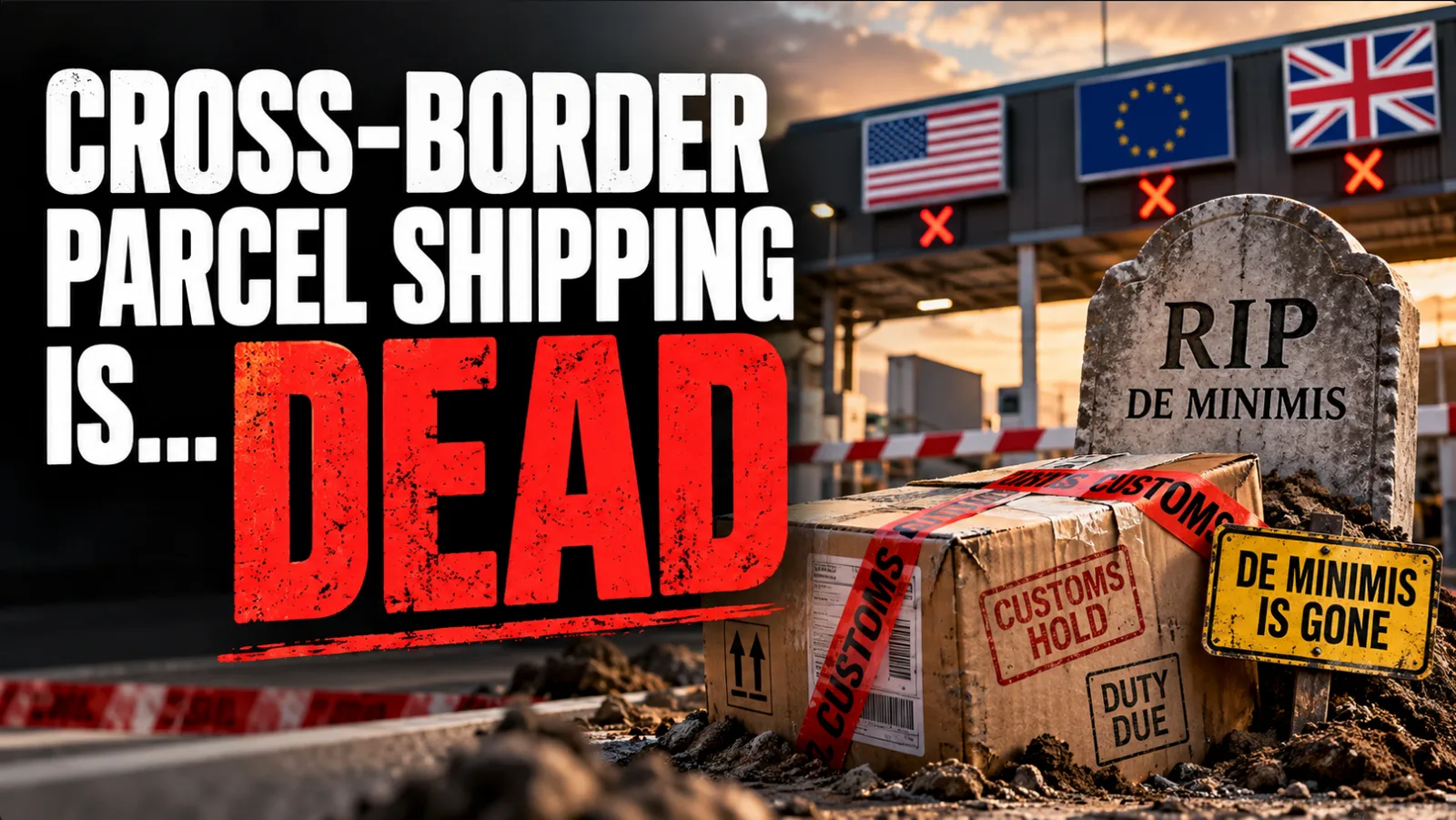
The exemptions that built direct-to-consumer e-commerce are being switched off, in every market that matters. Here’s what replaces them, and the customs-duty levers many brands are yet to have pulled.
Now, I know dead is a strong word and won’t win me any fans from my own network of cross-border parcel specialists.
Remember I worked in that world myself for over a decade, so I have chosen it carefully.
For that decade, global DTC e-commerce ran on a quiet bit of plumbing called “the de minimis”: the value below which a parcel crosses a customs border without any duty being applied and barely a glance from the receiving customs authority in the destination country.
Ship a £40 order to an overseas country from Shenzhen, Swansea, Shanghai or anywhere else straight to an online customer’s door, and the customs border in the country the customer resides in simply waved it through their clearance process.
That plumbing is being ripped out. Not in one market. In all of them, all at once.
There’s a line in the customs valuation rules that turns this from a cost problem into a competitive edge for retailers that operate in a certain way. I’ll get to it.
First, the scale of what has recently happened across the globe.
The loophole that became the front door
De minimis was designed to spare customs officers from inspecting low value, low risk items like socks, for example.
It ended up carrying most of the world’s e-commerce parcels.
US de minimis shipments grew from 134 million in 2015 to over 1.36 billion in 2024, according to US Customs and Border Protection. By the end, CBP was clearing more than 4 million parcels a day, an estimated 92% of all US import entries by volume. The declared value came to $64.8 billion in FY2024, on an average parcel worth just US$54.
Two names drove most of it. At the peak, SHEIN and Temu were shipping around 600,000 packages a day into the US between them.
Zoom out and the number gets properly big: China exported roughly US$240 billion of de minimis-eligible DTC goods worldwide last year, about 7% of everything it exports.
When an exemption becomes 92% of your import entries, it isn’t an exemption any more. It’s the business model.
Every treasury of all the major consumer markets on planet earth noticed this at roughly the same time, and then changed the rules to fight back against it.
They all pulled the same lever inside of eighteen months:
- United States: suspended for China and Hong Kong on 2 May 2025, then for every country from 29 August 2025. Congress has now repealed the provision permanently, effective 1 July 2027.
- European Union: the €150 duty exemption ended on 1 July 2026, replaced by a flat €3 duty charged per four-digit tariff heading, not per parcel, until the Customs Data Hub goes live in 2028 and full tariff rates apply to everything.
- United Kingdom: the £135 relief goes by March 2029 at the latest.
- Mexico: a 19% courier duty from January 2025, lifted to 33.5% on 1 January 2026.
- Thailand: its THB1,500 threshold scrapped on 1 January 2026. Vietnam went the year before.
- Australia and Singapore: kept their thresholds but made overseas sellers register and collect GST (VAT) at the checkout.
That isn’t one government having a tantrum. It’s a coordinated re-pricing of an entire way of moving goods, and the direction of travel on this only runs one way.
The part most brands haven’t costed yet
When you ship a parcel across a border to a consumer, the sale for export and customs duty valuation is the retail sale.
This is what determines how much customs duty is due. Under the World Trade Organization (WTO) valuation rules every one of these markets runs on, your dutiable value is what you sold the goods for: the retail price.
Read that again. You’re paying duty on your full margin.
Then stack on the per-parcel fees, the clearance friction, the slower delivery through parcels having to be cleared.
And, on DDU transactions, a customer getting a “pay before we release your order” text or notification, when they thought they’d already checked out and paid in full for the thing they ordered from you.
Every parcel becomes a separate customs event, a separate charge, and a separate chance to lose someone who’d already said yes.
At ten orders a week, it’s annoying. At a thousand a week, the maths turns ugly, fast.
Pay duty on the cost of the goods, not what you sold them for
Now the line I promised.
Import that same stock in bulk into a 3PL warehouse in-market, and the duty valuation is no longer calculated on the sale price for export. It’s calculated on your purchase price, from the factory.
Customs values the goods at what you paid for them (plus freight to the border in the UK and EU; the US is kinder still and values at the factory gate).
A worked example, because this is the whole game:
- Product retails at £100. Cost plus freight to the border: £30.
- Cross-border parcel: duty assessed on £100.
- Bulk import into a local 3PL: duty assessed on £30.
Same product, same customer, same doorstep. Dutiable base down roughly 70%. Your retail margin gets added after the goods have cleared, on domestic soil, where the border controls don’t reach it.
And here’s why that’s real profit rather than a paper saving: duty is the one cost you can rarely get back. Import VAT, a registered importer reclaims. Duty just leaves. Shrink the base you pay it on and the difference lands straight on the bottom line.
One customs event instead of a thousand events, and a duty bill built on your cost sheet rather than your sell price. That isn’t a workaround.
That’s how the rules were written.
The BIG caveat
Localisation of inventory isn’t right for every brand.
Holding stock overseas means capital tied up, a VAT registration and reconciliation process, a 3PL relationship, and you have to have demand you’re confident enough to forecast.
Below a certain volume, parcel-by-parcel, while potentially painful and expensive, is still cheaper than the fixed cost of a second stock location.
But the line where that maths flips has moved, sharply, in the last eighteen months. Every threshold that disappears drags it lower, country by country.
Brands that sat comfortably below this line in 2024 are above it in 2026. And many haven’t noticed yet, because the extra costs arrive incrementally as a hundred small duty charges rather than one big line on an invoice.
The bottom line
Cross-border parcel shipping isn’t dead because governments dislike all incoming parcels.
It’s dead as a default way of operating because the one thing that ever made it cheap has been deliberately switched off, everywhere, on a published schedule.
What replaces it is localisation, moving from the exception to the norm: stock held in-market, close to the consumer, cleared once at cost instead of a thousand times at retail.
Faster delivery. No doorstep surprises. A duty bill calculated on what you paid for the goods, not what you charge in-country consumers to buy them from you.
The old regime rewarded shipping from far away. The new one rewards already being in-market with your inventory.
The individual parcel may not have needed to cross the border. Your stock did in order to reach the consumer.
Where SHIPMAX comes in
We are seeing this trend playing out in real life.
Last year all the focus from the brands we serve was on the US market. This year the conversations are more EU focussed, but we are having them daily with forward-thinking brands that are looking to get ahead of the pack on this.
If your fulfilment model was designed for a world that still had lots of generous de minimis thresholds, it needs a proper review, not a guess.
Take it as a clue or a signal that both Temu and SHEIN are localising their stock holdings, in the countries where they have the greatest consumer demand. The two Chinese players that started this trend in the first place are now investing massively in localised warehousing to defend against it.
SHIPMAX helps brands work out exactly when localising stock flips from an expense into an edge, in the UK, EU or US, or anywhere else. We then find the vetted 3PL partners to make it work.
Brands don’t pay for this when they engage us. Our partner network does. So, our only job is to find the right-fit 3PL for your volume, margin and growth ambitions.
We are here to help brands optimise their P&Ls through tightening these areas of their supply chains, while remaining in the driving seat throughout the process.
The rules are moving and changing fast. Get ahead of them.
Book a call, or drop an email to hello@shipmax.co.uk, and let’s see if SHIPMAX can help your brand sell more, profitably.
Best, Phil
Founder, SHIPMAX LTD