Diesel's a Penny Off £2. Your Supply Chain Is Already Paying.
Crude is back near $100, diesel is flirting with £2, and a fuel duty rise lands in January. Where fuel volatility hits your supply chain, and the fix.
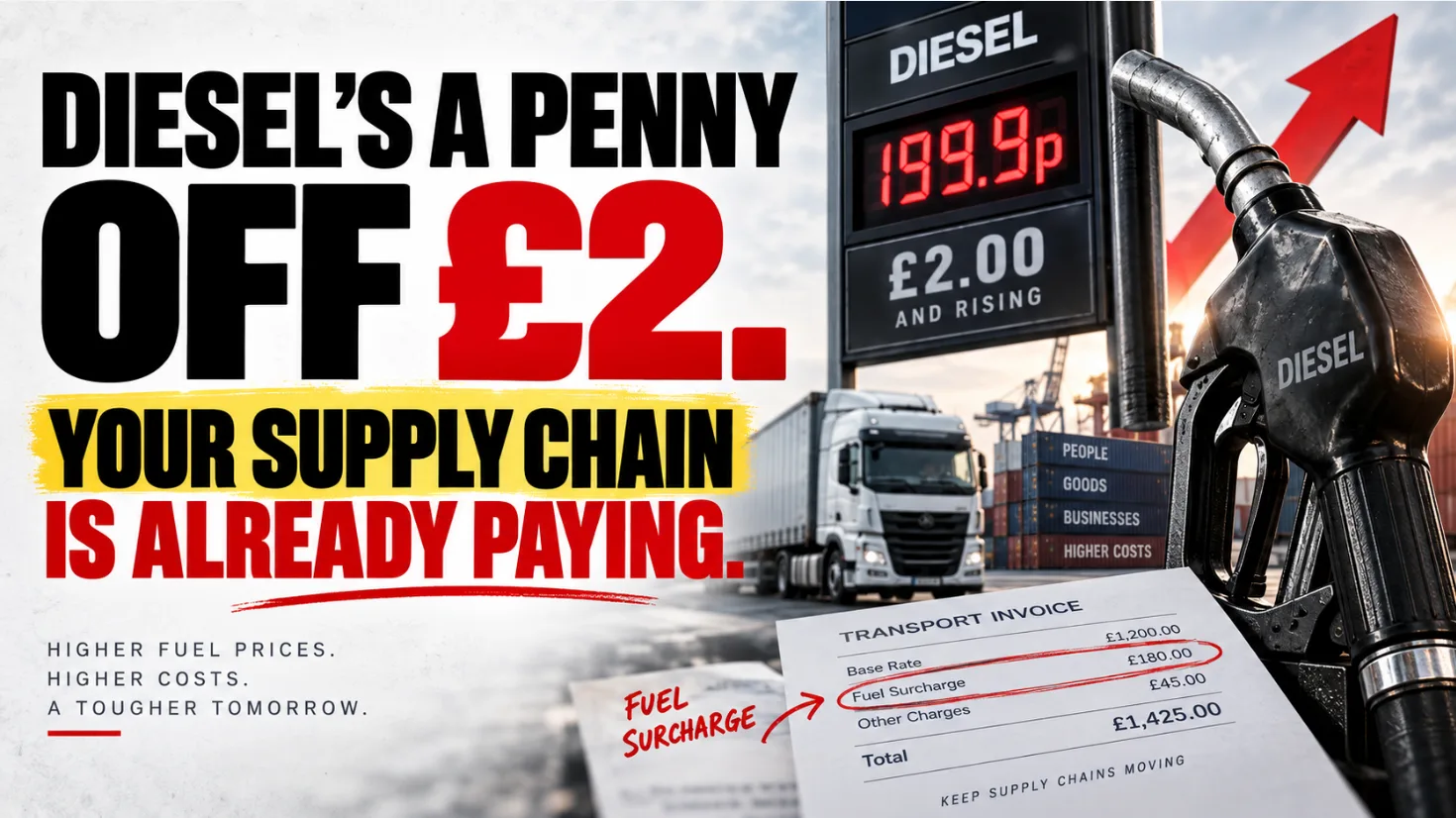
Diesel is having a moment. Not the good kind.
The UK average forecourt price reached 196.4p a litre on 20 September. Around one UK forecourt in ten is now either charging more than £2 for diesel or sitting at 199.9p, a single price move away. For context, the government’s weekly average was 140.72p in the week of 9 February.
That isn’t a spike you wait out. It’s a new floor with a trapdoor underneath it.
Why it’s happening
The short answer is the Middle East. Brent crude closed around $100 a barrel on 21 September, roughly 50% higher than a year ago. Saudi Arabia has suspended its East-West pipeline, the 1,200km route that lets its oil exports avoid the Strait of Hormuz. Houthi forces have also taken islands near the Bab el-Mandeb chokepoint, raising fresh concerns for shipping through the Red Sea.
The oceans aren’t offering much relief either. Drewry’s World Container Index stood at $4,500 per 40ft container on 17 September. Singapore bunker fuel costs are up about 60% year on year, and carriers such as ONE are raising their emergency fuel surcharges. On the other side of the world, rainfall across the Panama Canal watershed ran 34% below average from May to August, and daily transits dropped to 32 from 15 September.
UK brands also have their own date in the diary. The 5p fuel duty cut expires on 31 December. Duty rises 3p a litre on 1 January 2027, then another 2p on 1 March. The Road Haulage Association puts that at an extra £2,325 a year for every lorry on the road.
It won’t show up on your rate card
Most freight and delivery contracts split the price in two. The base rate is the number everyone benchmarks when comparing quotes. The fuel surcharge sits alongside it and moves on its own, usually tracked weekly against a published diesel index.
When diesel climbs, that surcharge climbs with it. It moves automatically, on a schedule you didn’t set, and you usually only see it once it’s been billed.
That’s the real cost of rising oil. It isn’t the headline price. It’s a line item that compounds quietly every time crude moves, and it sits on top of a base rate you negotiated hard for.
You’re probably comparing the wrong number
Two logistics quotes can look identical on the base rate and still end up far apart on true cost per order. The difference is simply that one has a weekly-indexed fuel surcharge and the other fixes fuel into an annual rate.
Sticker price tells you who quoted sharpest on day one. It tells you nothing about who’s cheapest by month twelve.
The risk that never appears on an invoice
Cost is only half the story. The RHA says fuel is roughly a third of a haulier’s costs, and margins sit at around 2%. Only about one operator in ten can pass higher fuel costs on in full, and around 150 haulage businesses had already failed by July.
So the cheapest carrier in your supply chain might also be the one least likely to still be trading at peak. A surcharge dents your margin. A carrier collapse in November loses you whole orders.
What to actually do about it
- Ask about the mechanism before you ask about price. Is the fuel element indexed or fixed? If it’s indexed, which index does it follow, from what baseline, how often is it reviewed, and is it capped? Indexed isn’t automatically worse, it works in your favour when prices fall. You just need to know which one you’ve signed.
- Track landed cost per order, not headline rate. A partner that quotes a little higher but holds fuel to an annual review is often cheaper twelve months in than the one that looked best at tender.
- Map where your exposure actually sits. Brands that rely heavily on road and last-mile delivery feel diesel first. Importers get hit several times over: once on ocean freight, again on port haulage, and again on the domestic leg.
- Put 1 January in the diary now. The duty rise is one of the few cost increases this year that comes with a date attached. Ask your suppliers how they plan to pass it on before they tell you.
- Price for it before oil does it for you. If fuel can move your supply chain costs, it can move your margin. It’s far better to build that into your own pricing than to discover it on an invoice.
The bottom line
This isn’t going away soon. The US EIA forecasts that Brent will average around $90 a barrel through the second half of 2026. The brands that get hurt aren’t the ones paying the surcharge. They’re the ones who found out about it from an invoice rather than a conversation.
Reviewing a logistics or fulfilment partner this year? SHIPMAX will ask the fuel questions for you, and brands pay nothing for it. Book Now