Searching for a 3PL? Check This First!
The 3PL search doesn't usually stall because 3PLs are hard to find. It stalls because brands can't answer basic questions about their own operation. Here's what to have ready.
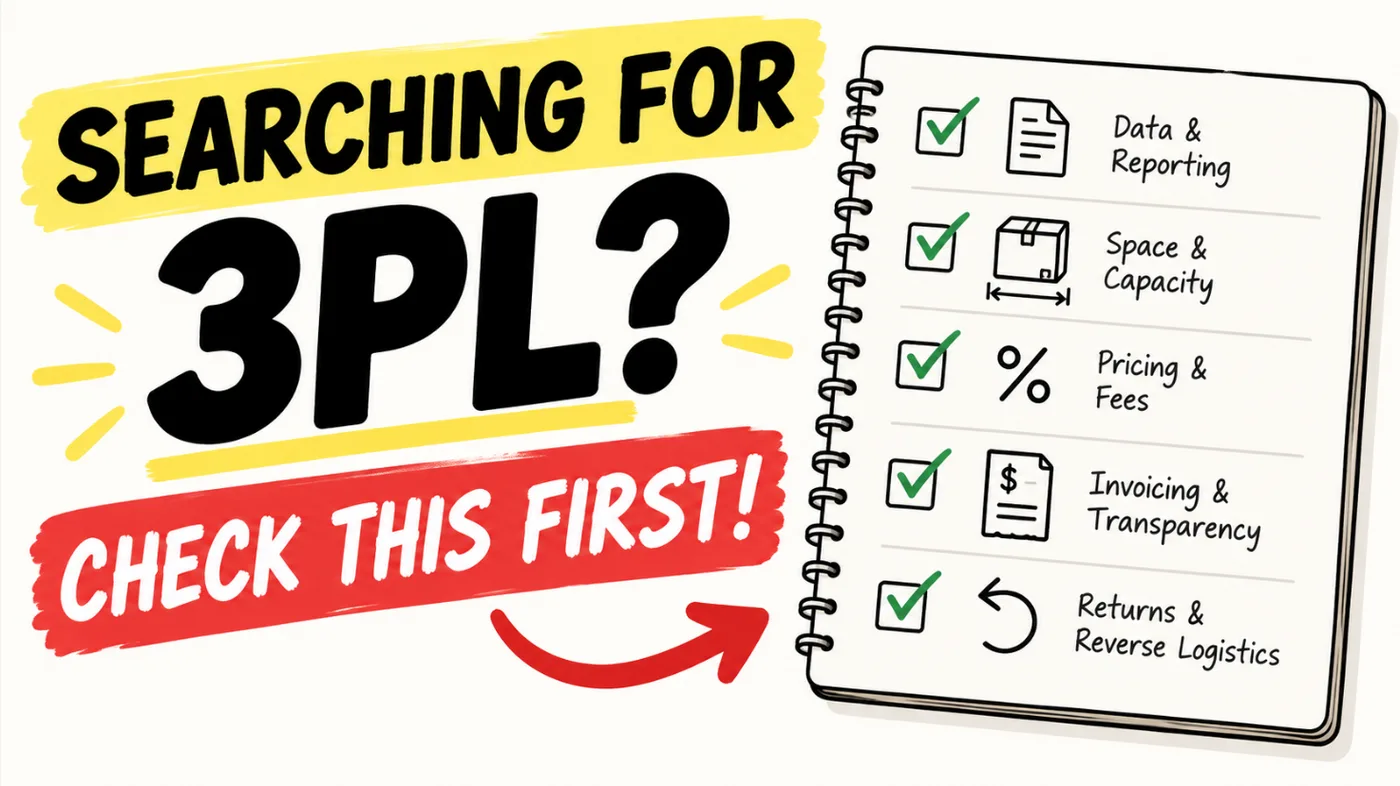
You email five 3PLs. Three reply. Two ask a follow-up question you can’t answer off the top of your head.
“How many SKUs are kitted?”
“What’s your true dims and weights, not the box the supplier quoted?”
“What percentage of orders are multi-line?”
You say you’ll pull that. Two weeks later, you still haven’t.
The problem isn’t finding a 3PL. It’s your own data.
Most brands assume a 3PL search stalls because good partners are hard to find, or because everyone’s too busy to reply. That’s rarely it. It stalls because the brand can’t answer basic questions about its own operation without going away and pulling a report first.
No VAT number ready. No EORI number if you’re shipping cross-border. No real SKU count. Dimensions and weights estimated from memory, not measured. Order volume quoted as “a few hundred a month, roughly.”
None of that is unusual. Most founders and ops leads are running the business, not auditing it. But it’s exactly the gap that turns a fulfilment search into a six-week email thread.
So what happens if you go in without it
Meetings slip. Not because anyone’s ghosting you, but because “let me get back to you on that” has no deadline attached to it. A conversation that should take a week stretches to a month while everyone waits on the same missing numbers.
Worse: if you do get quotes without solid data behind them, they’re built on the 3PL’s assumptions, not your reality. Estimated dims come in lighter than your actual product. Order profile guesses miss how many of your orders are multi-line, which is exactly what drives pick-and-pack cost. The quote looks competitive on paper. Then you go live, the real numbers show up on the first invoice, and the “cheap” option is suddenly not so cheap.
You end up doing the data work anyway. You just do it after signing, under worse conditions, with a partner who already has your business.
What to actually have ready
You don’t need a perfect data warehouse. You need five things, and most of them live in a spreadsheet you already have open somewhere.
- VAT number, and your EORI number if you’re shipping into or out of the UK/EU. Basic, but it’s the first thing that stalls a quote if it’s missing.
- Full SKU list with real dimensions and weights. Measured, not estimated from the supplier’s spec sheet. Products change. Packaging changes. A 3PL pricing off the wrong dims will either overprice you or underprice themselves, and neither is a good place to start a relationship.
- Order profile. Monthly volume, and the split between single-line and multi-line orders. Multi-line orders take longer to pick and cost more, and it’s one of the most common gaps between a quoted rate and what actually lands on the invoice.
- Current rate card or invoices, if you’re switching rather than starting fresh. Without them, nobody can tell you whether a new quote is actually better, only whether it’s cheaper on the one line item you both happened to compare.
- Return rate and returns process, roughly. Even a rough percentage lets a 3PL price it properly instead of guessing and building in a buffer you end up paying for either way.
None of this needs to be perfect. Bounded estimates are fine, as long as you can defend where the number came from. What kills momentum isn’t imprecision, it’s not having an answer at all.
The brands that move fast do this first
The pattern holds every time: brands who turn up with these five things ready get properly matched and moving within days. Brands who don’t spend the first few weeks of their “3PL search” doing an inventory audit by email, one question at a time.
Pull the numbers before you send the first message, not after the first 3PL asks for them.