How to Read a 3PL Rate Card (Without Getting Stung on the Invoice)
3PL quotes look simple until month three. How to compare rate cards on true cost per order, not the headline pick fee, so 'cheap' stays cheap.
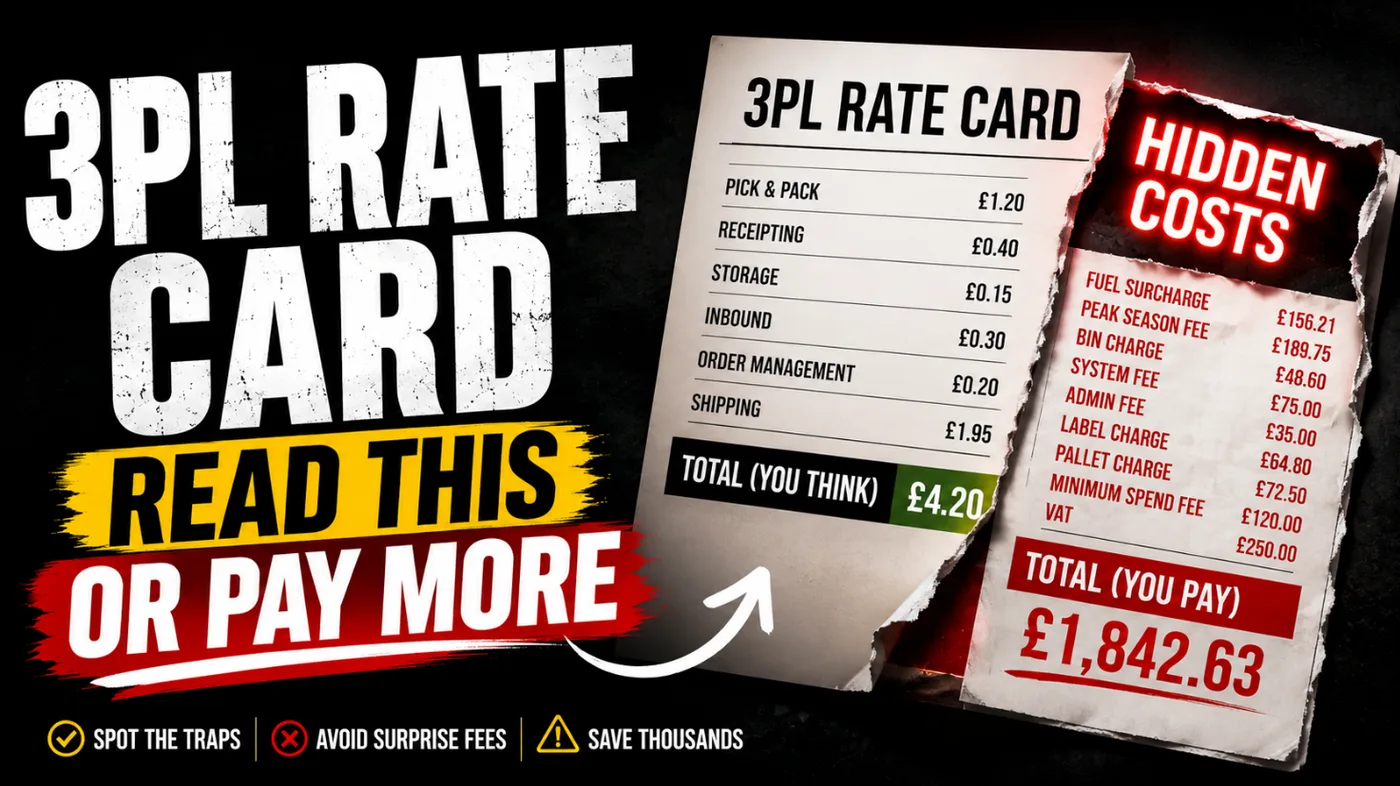
You’re benchmarking 3PLs on the headline pick fee.
Fair enough. It’s the number at the top of the quote, it’s the easiest thing to compare, and it’s what most spreadsheets get built around.
Here’s the problem: it’s also the smallest lever on your actual invoice.
So what happens if you pick on pick fee alone?
You sign with the cheapest-looking quote. Six months in, your true cost per order has crept past what the “expensive” one quoted. You saved on the sticker and lost on the invoice, every single month, and by now you’re too deep into onboarding to want to switch again.
That’s not bad luck. It’s what happens when two 3PLs price the same job in completely different units, and nobody standardised the comparison before signing.
Why rate cards don’t compare cleanly
Two quotes for the same order profile can look 15% apart on pick fee and land in the same place, or further apart, once everything else is added in. The gap hides in the line items that don’t make it onto the summary page:
- Storage minimums. A low per-pallet rate means nothing if there’s a monthly minimum charge that assumes far more volume than you’re actually storing.
- Packaging. Some quotes include a standard mailer or box in the pick fee. Others charge it as a pass-through, at a markup you won’t see until the first invoice.
- Peak surcharges. Black Friday and December pricing can run well above the base rate. If the quote doesn’t show you the peak multiplier, ask for it before you sign, not after your first November with them.
- Carrier correction charges. When a parcel’s actual weight or dimensions differ from what was booked, most 3PLs and carriers rebill the difference, sometimes weeks later, sometimes at a punitive rate.
- Account management and reporting. A “free” quarterly business review is standard at some providers and a paid add-on at others.
- Returns processing. Often quoted separately, or not quoted at all until you ask directly.
- Minimum order values. Some contracts have a monthly minimum spend regardless of actual volume, which matters a lot if you’re seasonal.
None of these are hidden in a dishonest sense. They’re just priced in different units by different providers, which makes a side-by-side comparison meaningless unless you force it into the same shape first.
The fix: model total cost per order, not pick fee
Take your actual order profile (monthly volume, peak multiplier, SKU count, average parcel weight and dimensions, returns rate, packaging complexity) and run every quote through it, line by line, using the same assumptions each time.
That means asking every 3PL on your shortlist the same questions, in the same order, before you compare a single number:
- What’s included in the base pick fee, and what’s charged separately?
- What’s the peak-period multiplier, and when does it apply?
- Is there a storage minimum, and is it based on my actual footprint or a assumed one?
- How are carrier weight/dimension corrections billed, and how often?
- What does an exit look like: data export, stock reconciliation, final stock-move fees?
Once you’ve done that, the gap between “cheap” and “expensive” quotes usually narrows or reverses entirely. The provider that looked 10% pricier on pick fee alone is often the one with no storage minimum and a sane peak multiplier, which makes it materially cheaper across a real year.
This is the exact model SHIPMAX’s Lead Exchange runs behind every match: brands aren’t scored against 3PLs on price alone, they’re scored on operational fit against a standardised order profile, so the numbers a founder sees are already comparing like for like.
If you’re mid-comparison right now, the fastest thing you can do today is stop reading quotes top to bottom and start reading them line by line against each other instead. The headline number was never the whole story.
Book a Call or email hello@shipmax.co.uk.
Not moving 3PL this year? Save this article for when you are.
Best, Phil
Founder, SHIPMAX LTD